Pronunciation Guide: the letter ā is pronounced like the a in ball or call; the letter a is pronounced like the u in hut or luck.
Abhishikta – literally, “the anointed one”, similar to Jewish term messiah
Agarbati – incense
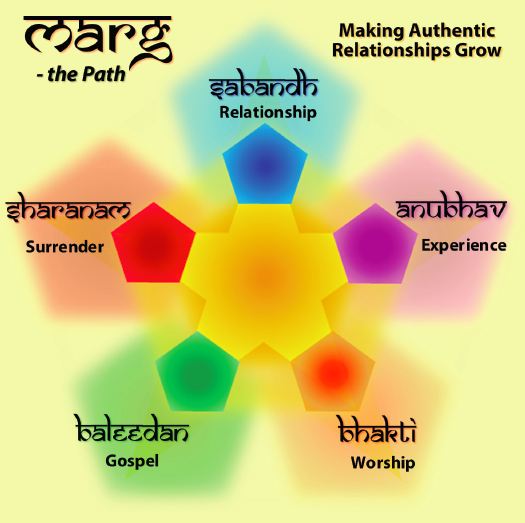
Anubhava – experience, especially spiritual experience
Ārati – the circular waving of lights (diya) in front of a deity or person being honored.
Āshram – place of retreat, or the four stages of life
Ātma / Ātman – breath or spirit, often translated soul or self, but usually very different from the (complex) biblical concept of soul. In many cases the term refers to “God considered as immanent in human personality.”
Āvatār – belief (particularly in Vaishnavism) that God “descends” into history to restore good (dharma) on earth
Bhagavad Gitā – (often just Gitā) –”Song of God”, a brilliant synthesis of Hindu philosophical ideas with a strong emphasis on bhakti.
Bhajan – a spiritual song, or a song service with antiphonal singing between leader and congregation
Bhakta – a devotee
Bhakti – personal devotion to a deity
Bindi – dot, particularly the red dot on the forehead of a worshipper (also worn as make-up and/or a status marker on married women)
Brāhman/Brahman (usually the same in English spelling) – Brāhman is the highest caste, traditionally priests (Brahmin is an antiquated spelling); Brahman is the world spirit or foundational reality of everything
Caste – four-fold varna (Brāhman, Kshatriya, Vaishya, Sudra) or unnumbered jāti (social unit within which one may permissibly marry), both are subsumed under English “caste”, social hierarchies under transformation by modernity
Chandan – sandalwood from which a fragrant paste is often applied to the forehead
Community – the caste and social network which provides comprehensive support
Conversion – changing religion and thus also community affiliation
Dalit – the oppressed, formerly outcastes or untouchables
Darshan – visual contact with a deity or guru
Dharma – duty, righteousness, order, that which sustains society, etc.
Dikshā – rite of initiation
Diyā – lamp; traditionally made of clay or brass and burning oil on cotton wicks; lights are invariably part of pujā
Guru – spiritual master or teacher
Ishta devatā – a deity of one’s personal choice
Karma – deeds, and the philosophical concept that deeds lead to results and either merit or demerit which is rewarded/punished in future lives (samsāra). Often wrongly considered an absolute and fatalistic system.
Kirtan – a service of spiritual song, used with varying shades of meaning in different regions of India
Jāti – the extended family clan of which there are un-numbered thousands
Ji – an affectionate, honorific, gender neutral suffix attached to names
Mahābharāta – One of two epic poems, largely the story of Krishna’s exploits in a (the) great Indian war.
Mandali – a group, assembly, or congregation gathered for a shared purpose, such as fellowship or spiritual practice
Mandir – a Hindu temple, usually dedicated to a primary deity with representations of other deities also present
Mantra – technically a Vedic text, but more popularly is any word or phrase of spiritual provenance; considered to have great power
Mārg – road or path, used for ways of salvation which include gyāna mārg, (path of knowledge/wisdom), karma mārg (path of works, either ritual duties or (modern) social service), or bhakti mārg (path of devotion to God/a god)
Mukti – emancipation / salvation
Muktināth – Sanskrit for “God of Salvation” (literally, mukti = salvation, nāth = god). Amongst some Yeshu bhaktas, the preferred term for Jesus
Om – the sacred syllable to which many meanings are ascribed; functionally an indicator of a spiritually-focused encounter
Pavan Ātma – literally, “Holy Spirit”
Pavitra – literally, “holy”
Prasād – grace, but also items (particularly food) offered in worship (pujā) and then distributed as a blessing to worshipers and others
Pujā – worship; the common practice with many variations involving chanting, singing, offerings of flowers, fruits, incense, ārati, etc.
Purānas – the last (voluminous) set of sacred Sanskrit texts with stories of gods and goddesses and their exploits
Rāmāyana – the Sanskrit epic poem of Ram, retold in many variations into all the vernacular languages of India
Samsāra – the world, but also the cycle of life or reincarnation (often linked with its cause in the phrase karma-samsāra)
Sanātan dharma – a common phrase referring to traditional (“eternal”) ways; often preferred over the modern term “Hinduism.”
Sadguru – the true and final guru
Sādhana – spiritual method or disciplined path towards spirituality
Satsang – a spiritually focused meeting, often with song and teaching (literally a “truth gathering” or “reality encounter”)
Sevā – service
Shānti – peace
Sindoor – red powder/paste applied especially to the part of the hair of a married woman
Swāmi – Lord, master, an esteemed spiritual leader, often someone who has taken vows of renunciation (addressed as swāmiji; see ji above)
Upanishads – the last section of Vedic scripture, philosophical musings on the origin, meaning and end of life
Vedas – in the narrower sense, four collections of poems/songs from ancient times; in the broader sense those four collections along with ritual texts (Brāhmanas) and philosophical musings (Upanishads).
Yeshu – Hindi for “Jesus”; other common spellings are Yesu (Telugu), Jesu (Tamil), Isu (Gujarati), Jishu (Bengali), Yisu (Punjabi), Yeshu (Malayalam), Isa (Urdu)
Yeshu Bhakt – literally, “Jesus devotee”
Yoga – many meanings, philosophical and practical. Modern postural yoga is neither ancient nor philosophical
Names for God:
Bhagwān – for many Hindus the heart-term for the object of devotion, a word for God avoided by some Christians
Deva/Devan – the term for God in most south Indian language Bibles
Ishwar – the term for God in most north Indian language Bibles
Paramātma – Supreme Spirit or God
Parameshwar – “supreme Ishwar”, standard word for God in north India