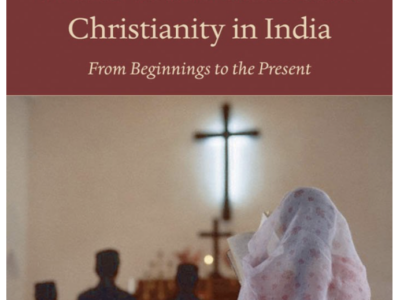
Indian and Christian: Historical Accounts of Christianity and Theological Reflections in India, by Lalsangkima Pachuau (IJFM 36:3, Fall 2019 pp. vii+198) —Reviewed by H. L. Richard
This brief collection of seven previously published essays constitutes an excellent introduction to Christianity in India and issues related to the gospel among India’s peoples. In his brief introduction the author refers to an “epistemic moment” on noticing a book on Ethno-nationalism; that term encompassed a reality that the author, a Mizo from the far northeast of India who is Dean of Advanced Research Programs at Asbury Seminary, had not yet been able to put his finger on. He goes on to describe his book by saying that “At the heart of these accounts is what it means to be an Indian Christian.”
Part one is three essays on “Indian Christianity and Indian National Identity.” The first essay is a stimulating discussion of Mahatma Gandhi and his meaning in and for Indian Christianity. The title is profound and provocative: “Mahatma Gandhi and the Dalit Movement to Christianity in India: Clashing of ‘Mass Movements.’” Complex and controversial topics are handled with carefully nuanced arguments as the significance of nationalist India to Christianity is drawn out. Gandhi’s discomfort with conversion has had a great influence on modern India; missionary and Indian Christian discomfort with Gandhi is helpfully analyzed. The practical wisdom evident through- out this small book is seen in the concluding sentence of his first chapter:
One should also recognize that Gandhi’s disapproval and denigration of the missionary practice of mission also challenges Christians to be prudent in their understanding of conversion and practice of mission. (41)
Chapter 2 develops the Gandhian angle further by looking at nationalism and Indian Christians. This begins with a stark acknowledgement that “only a small minority elite group of Christians participated in the nationalist movement” (48). This is then nuanced with the fact that the nationalist movement was an urban elitist movement, and most of Indian Christianity was rural and poor and low caste, segments of the populace that in general were not interested in the political agitation. The main impact of the nationalist movement on Indian Christianity is seen in strong moves to make the church more Indian. This is traced through the Madras Rethinking Group, the Christian ashram movement, and the much more conservative Indian Theological Conferences up through the dialogue and nation building focus to the emergence of Dalit theology.
Chapter 3 looks at the transition from foreign missions in India to the indigenous missions of the Indian church in the post-independence period. This includes a valuable summary of the progress of policies restricting foreign missionaries beginning in the early 1950s. The development of indigenous Indian missions is easily traced in early independent organizations, but gets too complicated for neat summary as foreign missions always relied heavily on local workers and then eventually passed on all responsibilities, and many independent churches and individuals are active now.
It is impossible to know how many Indian missionaries are working in India today. But it is clear that there are more “missionaries” in India today than ever before, and almost all of these missionaries are Indians. (97)
This chapter includes brief discussions of the evangelism vs. social action tension as it manifested in India, and on following Jesus outside of Christianity.
Part two is two chapters on “India’s Theologies in Their Religious Contexts.” The fourth chapter is perhaps the most ambitious in the book, as it takes on the interaction
of Hindu and Christian traditions, focusing on their views on sacred texts. After summarizing Hindu views of scripture, the Hindu response to Christ and the Bible comes into focus, referencing both fundamentalist anti-Christian responses and positive absorption-of-Christ syncretism. Pachuau concludes his survey saying that “There is no room for haste in the Hindu world. The biblical message and essential Christian beliefs will have to be translated into practical and realistic living principles” (123). And the
encounter of the gospel with Hindu traditions has to be from inside those traditions, not as an attack from a foreign religion (122–124).
Chapter 5 turns to the author’s own Mizo people of north-east India, also the focus of his doctoral work. He begins with the confusion over “religion” and “tribal religion” based on the alien worldview of missionaries imposed onto an indigenous term.
Any study of the primal religion of most tribal groups such as the Mizos must avoid the highly western sacred-profane dichotomy and look at the entire socio-cultural life system for the meaning of the people’s religion and religiosity . . . The interconnectedness of all aspects of life in the society and the interlocking meanings of symbols of various domains of life do not permit such clear dichotomy, as life is seen as treated as one whole. (128)
The chapter goes on to argue against the idea that tribal ways were all abandoned in favor of the new way of Christianity; rather “traditional primal religion, as well as religiosity live on in some form to become a foundation for the newly embraced Christian religion”(129). The total conversion of Mizos in about half a century shows there was residence in serious areas, is outlined in this chapter. Even the Mizo Christian focus on revivals is traced to their tribal heritage. This is stimulating and important material for theological reflection.
The final section of two chapters is on “Christianity and Nationhood in Northeast India.” Chapter 6, surveys the seven states in the region and how Christianity was introduced. This is an excellent brief summary of the area we’re over a quarter of Indian Christians live. (157). In a one sentence summary:
If one is to give an interview of how Christianity spread in Northeast India, and may be said that the missionaries initiated the movement by introducing Christianity to a few individuals, and the native converts spread it. (175)
The concluding chapter “is a modest attempt to highlight the complexities of ethno-politics in northeast India” (194). Serious political unrest and movements to separate from India in the most Christian part of the country contribute to India’s unease with Christianity. Dual influences of Sanskritization or Hinduization and westernization are noted. “Tribal” identity is a constitutional category. (“Scheduled Tribes”) but this is hardly a meaningful designation due to the diversity of people across India who are so listed.
The list of criteria includes “tribal language, animism, primitivity, hunting, and gathering, ‘carnivorous in food habits’, ‘naked or semi-naked,’ and fond of drinking and dance.” the list, in my opinion, is simply absurd; and the criteria do not match those listed. (190)
This is simply ethnocentric prejudice, and “an honest recognition of the pain and the harm caused by [this] marginalization” (194) is a necessary part of solving the political tensions. But this is a double–edged issue, “Northeasterner also need to self – critically examine the practice of stereotypical constructions of the image of the ‘outsiders.’” (194)
There are so many Christianity in India, and so many complex challenges in that vast nation that a simple introduction is impossible. This book is not simple, and does not shirk the complexities of the gospel encounter with both existing Christianities and the variegated cultural traditions of India. It is not by any means a thorough introduction to Christianity in India, but it is a well-reasoned engagement with that complex world and is highly recommended for anyone who wants to start towards an understanding of that fascinating sub-continent and what “good news” means in worlds so foreign to traditional Christendom.
Article Pull Out Quotes
Pachua concludes his survey saying, “There is no room for haste in the Hindu world. The biblical message and essential Christian beliefs will have to be translated into practical and realistic living principles.”
- H.L. Richard is an independent researcher focused on the Hindu-Christian encounter. He has published numerous books and articles including studies of key figures like Narayan Vaman Tilak (Following Jesus in the Hindu Context, Pasadena: William Carey Library, 1998), Kalagara Subba Rao (Exploring the Depths of the Mystery of Christ, Bangalore: Centre for Contemporary Christianity, 2005), and R. C. Das (R. C. Das: Evangelical Prophet for Contextual Christianity, Delhi: ISPCK, 1995).